Monday, July 12, 2010


Sunday, July 11, 2010
The Good News Corps

Founded in 2002 by the International Youth Fellowship Educational Foundation, the Good News Corps (GNC) has become one of the biggest overseas volunteer programmes for international students who wish to broaden their views of the world and set an example for a new generation of youth to engage in improving their society.
The Good News Corps, whose motto is “exchange your youth for their hearts”, creates opportunities for students to go overseas for one year in order to engage with every part of a foreign culture: language, cuisine, music, architecture, sport and traditional performances.
In the past eight years more than 2,000 students have devoted one year of their lives to serve in over 80 countries around the world. But while Cambodia has received many volunteers through the International Youth Fellowship (IYF), this will be the first year that Cambodia sends volunteers abroad (the deadline for applicants is July 23). “This is the first time that IYF in Cambodia is cooperating with the
Through activities like visiting hospitals and retirement homes, youth and community outreach programmes and journeys to remote areas, volunteers are able to deeply touch the lives of others.
By Mesa Lang
The Beach Clean Up Project

The Beach Clean Up Project, which is organized by ENRICH, a group of English-speaking youth at the Institute of Foreign Languages, was started to celebrate World Environment Day. This year 47 volunteers came together to spruce up Ochheuteal beach in Sihanoukville on June 5 and 6.
The efforts were not only meant to clean up the beach, but also to spread information to local youth and vendors, as well as tourists about the impact of pollution, and to encourage them to play more active roles in protecting the environment.
Project participants also designed posters and logos on rubbish bins and then celebrated a hard day’s work by playing beach games and joining in otherteam -building activities.
“We believe that this campaign encourages a better understanding of the environment among the people we reach out to,” said Sarin Sirivudh, the co-facilitator of ENRICH. He added that people involved can go on to set up clean-up projects in their own communities.
“This is a great opportunity to socialise with people,” said Hang Sopheak, a participant from the Royal University of Law and Economics.
“I believe that I will be able to learn skills such as leadership, communication, problem solving and teamwork from my peers.”
ENRICH provides participants with both memorable experiences and an opportunity to improve their understanding of environmental issues, problem solving and teamwork.
The efforts were not only meant to clean up the beach, but also to spread information to local youth and vendors, as well as tourists about the impact of pollution, and to encourage them to play more active roles in protecting the environment.
Project participants also designed posters and logos on rubbish bins and then celebrated a hard day’s work by playing beach games and joining in other
“We believe that this campaign encourages a better understanding of the environment among the people we reach out to,” said Sarin Sirivudh, the co-facilitator of ENRICH. He added that people involved can go on to set up clean-up projects in their own communities.
“This is a great opportunity to socialise with people,” said Hang Sopheak, a participant from the Royal University of Law and Economics.
“I believe that I will be able to learn skills such as leadership, communication, problem solving and teamwork from my peers.”
ENRICH provides participants with both memorable experiences and an opportunity to improve their understanding of environmental issues, problem solving and teamwork.
By Mesa Lang
Thursday, June 10, 2010
Going abroad for the experience of a lifetime

Because of a shortage of jobs in Cambodia, more than 50,000 Cambodian workers have travelled abroad since the country began to encourage workers to go to work in places like Thailand, Malaysia, South Korea, and Japan as housekeepers, construction workers, factory laborers, fishermen, fish cutters, shrimp peelers, and a variety of other manual-labor jobs.
Although the majority of Cambodians who step on a plane to work in a foreign country will be employed as low-skilled laborers, there is a growing number of Cambodians who have gone abroad to hone their professional skills in highly skilled jobs such as marketing, development and public relations. There are only a small number of Cambodians who have found professional success abroad; however, they prove that hard-working Cambodian students can develop the ability to work on an international stage.
“Whatever other people can do we can do,” said Chiv Sunheng, a graduate of the MBA program at Pa??asastra University of Cambodia and Junior Riparian Professional of the Mekong River Commission based in Laos. “When we study something must work hard to make sure that we understand and remember it. If we are not sure about our ability we will feel reluctant to look for a job and sit for interview,” he said.
As Cambodia becomes part of a globalized world, it is nessesary that Cambodians have the skills to perform and communicate on a internationally competitive level, and Cambodians have begun to bring their skills abroad and show their skill to the outside world.
Touch Yin Mony, a graduate from Royal University of Phnom Penh and a former intern at the European Parliament at
“I observed how powerful and influential work and tried to learn from their actions. I also built more personal networks worldwide, and I learned social and negotiation skills,” said Touch Yin Mony. He added that he was able to hone his negotiation skills when he had to handle difficult people in a professionallism and respectful manner.
Thoughworking abroad is a fantastic learning experience, the cultural diversity and high expectations are challenging to many Cambodians working abroad.
“You may have to face some challenges while working internationally, especially problems with languages, culture, different policies and competitiveness,” said Kim Sambath, a 21-year-old student in Limkokwing University’s Creative
In order to perform well in an international organization, Cambodian students have to be well- prepared academically and also socially. “We should be more social so that we can get to know many people around and share out ideas and comments, he said. “Ask yourself what is the job of your dreams and then start to improve yourself to fit the requirements of international companies in that field. Do not miss a chance to grab the opportunities in front of you. If you fail, try it again. Believe in your dreams and always say, ‘Yes, we can,’” he exclaimed.
Wednesday, May 12, 2010
World Camp 2010

The International Youth Fellowship (IYF) in cooperation with the Ministry of Education Youth and Sport is going to launch World Camp 2010 from May 16th to May 20th, 2010.
Established to cultivate leaders of the next generation under the motto of “Change, Challenge and Cohesion”, World Camp is a component of the IYF global youth organization that identifies the youth as drivers of change.
Thousands of students from every corner of the world and walk of life participate in the World Camp every year. The program has experienced remarkable success in South Korea, USA (Hawaii), Austria, Australia, Thailand, Malaysia, Peru, Paraguay, Mexico, Ghana, Kenya, Togo, Tanzania, Rwanda, and many other countries.
IYF World Camp is scheduled to be hosted by 30 countries for 2010, and Cambodia has been selected to be one of these countries. Naga World and National Institute of Education will be the venues inviting more than 1300 Cambodian and foreign participants to exchange experiences and ideas.
“IYF has been here in Phnom Penh since 2004, so I believe we are ready to embrace this opportunity to host the World Camp and showcase Cambodian culture to our family from other countries,” said Mr. Ha Cheol, Country Director of IYF in Cambodia.
He added that IYF World Camp, aims to broaden the hearts and minds of the youth so that they can see other cultures and freely interact and make friends through fellowships, seminars, lectures, concerts, cultural performances, academic workshops and mini Olympics.
The World Camp in Cambodia will also be marked by the presence of the President of IYF Mr Doh Ki Kwon, South Korean Ambassador to Cambodia H E Mr Lee Kyung-Soo, and Cambodian Minister ofMinistry of Education Youth and Sport H E Im Sethy to give a congratulatory address. The event’s keynote speaker is Pastor Ock Soo Park, IYF Chief Advisor, who will take the stage to deliver his message on education.
Beyond that, IYF Good News Corps Overseas volunteers, which includes students doing volunteer work in over 80 countries, will share their experiences in their overseas immersion through world culture exhibitions allowing other members to experience different cultures without having to leave the country.
“I never realized that there are people in every single corner of the world suffering hardships until I joined the Good News Corp of IYF,” said Kim Tae Hyun, a volunteer Korean student living in IYF Cambodia. Joining diversified but likeminded students at World Camp, we together are capable of sparking change and improvement.
Established to cultivate leaders of the next generation under the motto of “Change, Challenge and Cohesion”, World Camp is a component of the IYF global youth organization that identifies the youth as drivers of change.
Thousands of students from every corner of the world and walk of life participate in the World Camp every year. The program has experienced remarkable success in South Korea, USA (Hawaii), Austria, Australia, Thailand, Malaysia, Peru, Paraguay, Mexico, Ghana, Kenya, Togo, Tanzania, Rwanda, and many other countries.
IYF World Camp is scheduled to be hosted by 30 countries for 2010, and Cambodia has been selected to be one of these countries. Naga World and National Institute of Education will be the venues inviting more than 1300 Cambodian and foreign participants to exchange experiences and ideas.
“IYF has been here in Phnom Penh since 2004, so I believe we are ready to embrace this opportunity to host the World Camp and showcase Cambodian culture to our family from other countries,” said Mr. Ha Cheol, Country Director of IYF in Cambodia.
He added that IYF World Camp, aims to broaden the hearts and minds of the youth so that they can see other cultures and freely interact and make friends through fellowships, seminars, lectures, concerts, cultural performances, academic workshops and mini Olympics.
The World Camp in Cambodia will also be marked by the presence of the President of IYF Mr Doh Ki Kwon, South Korean Ambassador to Cambodia H E Mr Lee Kyung-Soo, and Cambodian Minister of
Beyond that, IYF Good News Corps Overseas volunteers, which includes students doing volunteer work in over 80 countries, will share their experiences in their overseas immersion through world culture exhibitions allowing other members to experience different cultures without having to leave the country.
“I never realized that there are people in every single corner of the world suffering hardships until I joined the Good News Corp of IYF,” said Kim Tae Hyun, a volunteer Korean student living in IYF Cambodia. Joining diversified but likeminded students at World Camp, we together are capable of sparking change and improvement.
Monday, March 15, 2010
Coming together to fight AIDS
By Mesa Lang and Tharo Sen
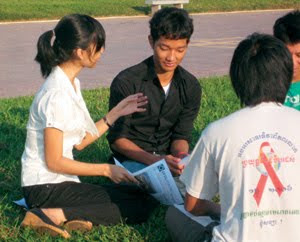

The Sustainable Aid for AIDS (S88) Conference, which aims to promote youth engagement in the fight against HIV/Aids, will be held this Friday at the Cambodian-Japanese Cooperation Centre (CJCC).
Since 1993 HIV/ Aids has become one of the most important health-care issues around the world. There has been a great effort in Cambodia and around the world to educate people about the disease and how it can be avoided. However, funding for HIV/AIDS-related social projects has been reduced by the economic recession, and there is also a belief among some that HIV/AIDS is not as big of a problem as it once was.
The S88 conference is meant to ensure that youths do not abandon the struggle against HIV/AIDS and that victims of the disease are given the opportunity to have a fulfilling and comfortable life. Discussions will focus on how the engagement of youth can lead to sustainable solutions to the problems posed by HIV/AIDS.
Friday’s conference has been organised by students from AIESEC in Limkokwing, in association with Seachange, with the overarching goal of facilitating community engagement by creating an environment that encourages youth to share ideas and participate in their society.
AIESEC Cambodia is currently cooperating with AIESEC students fromYale University in the United States to explore the potential of youth leadership and create a global learning platform through multi-national exchanges between students.
The events will bring together hundreds of youths from different schools and backgrounds who share a common vision to find sustainable ways of providing aid for
people with HIV/AIDS. There will be a number of organisations at the event providing students with volunteering opportunities related to HIV/AIDS.
Attendees will also have the opportunity to draw inspiration from the lectures given by Cambodian and international HIV/AIDS experts. To engage the audience in the topics being discussed, students will be put in groups, allowing them to have critical discussions and also build their social network.
“We all must work together in the fight against AIDS,” said Dapisei Sreng, who is a volunteer on the organisingteam of the S88 Conference. By coming together to talk about the challenges facing their community, young people can spark changes that will improve their country. You can join the movement for the improvement of Cambodia by joining likeminded students at the S88 conference on Friday.
Click here to see original version from Phnom Penh Post
Since 1993 HIV/ Aids has become one of the most important health-care issues around the world. There has been a great effort in Cambodia and around the world to educate people about the disease and how it can be avoided. However, funding for HIV/AIDS-related social projects has been reduced by the economic recession, and there is also a belief among some that HIV/AIDS is not as big of a problem as it once was.
The S88 conference is meant to ensure that youths do not abandon the struggle against HIV/AIDS and that victims of the disease are given the opportunity to have a fulfilling and comfortable life. Discussions will focus on how the engagement of youth can lead to sustainable solutions to the problems posed by HIV/AIDS.
Friday’s conference has been organised by students from AIESEC in Limkokwing, in association with Seachange, with the overarching goal of facilitating community engagement by creating an environment that encourages youth to share ideas and participate in their society.
AIESEC Cambodia is currently cooperating with AIESEC students from
The events will bring together hundreds of youths from different schools and backgrounds who share a common vision to find sustainable ways of providing aid for
people with HIV/AIDS. There will be a number of organisations at the event providing students with volunteering opportunities related to HIV/AIDS.
Attendees will also have the opportunity to draw inspiration from the lectures given by Cambodian and international HIV/AIDS experts. To engage the audience in the topics being discussed, students will be put in groups, allowing them to have critical discussions and also build their social network.
“We all must work together in the fight against AIDS,” said Dapisei Sreng, who is a volunteer on the organising
Click here to see original version from Phnom Penh Post
Sunday, March 7, 2010
International Women's Right Day
To celebrate the 99th anniversary of this year March 8th Women’s Right Day, the Ministry of Women Affairs, cooperating with Smart Mobile Company, has launched a big concert on March 4th, 2010 at the Olympic stadium.
The key main theme of this year celebration is “Bonding together to promote the potential for women and youth toward developed society”.
As the sun begins to set, the event is marked by the present of Her Excellency Men Sam Orn, the deputy minister of Cambodia; Her Excellency Dr. Ing Kantha Phavy, the Minister of Ministry of Women Affairs; other high ranking people.
“The day is to spot the equality between men and women,” said Dr. Ing Kantha Phavy, “and we must get rid of the culture of treating women as people who only deserve to do the household chores.”
Dr. Kantha Phavy added that the Women’s Right Day also an inspiration and motivation for women and youth to feel confident and actively participate in the field that men can do like engineer, minister or doctor.
To educate women on their right and liberty, the Ministry of Women Affair, the Cambodian National Council for Women (CNCW) and TWG-Gender have initiated a five-year strategic plan (2009-2013) called Neary Rattanak III aiming for gender equality and empowerment of Women in Cambodia by providing action, educating and training profession to support their living.
Heang Pheavy, the sale person from Smart Mobile Company, said enthusiastically at the stadium that she was very happy to be born in the country where women are given enough rights to live their lives, and she hoped this event can be effective to help other women in the world.
The key main theme of this year celebration is “Bonding together to promote the potential for women and youth toward developed society”.
As the sun begins to set, the event is marked by the present of Her Excellency Men Sam Orn, the deputy minister of Cambodia; Her Excellency Dr. Ing Kantha Phavy, the Minister of Ministry of Women Affairs; other high ranking people.
“The day is to spot the equality between men and women,” said Dr. Ing Kantha Phavy, “and we must get rid of the culture of treating women as people who only deserve to do the household chores.”
Dr. Kantha Phavy added that the Women’s Right Day also an inspiration and motivation for women and youth to feel confident and actively participate in the field that men can do like engineer, minister or doctor.
To educate women on their right and liberty, the Ministry of Women Affair, the Cambodian National Council for Women (CNCW) and TWG-Gender have initiated a five-year strategic plan (2009-2013) called Neary Rattanak III aiming for gender equality and empowerment of Women in Cambodia by providing action, educating and training profession to support their living.
Heang Pheavy, the sale person from Smart Mobile Company, said enthusiastically at the stadium that she was very happy to be born in the country where women are given enough rights to live their lives, and she hoped this event can be effective to help other women in the world.
Sunday, December 6, 2009
Cambodia's New High School Reform
By MESA LANG
“Its standard is very low.” “I do not want my children to be there.” These words were used by people to portray high school system in Cambodia.
High school education is a very crucial step for every student who wishes to pursue their knowledge in higher education. However, it seems like the system in high school, over decades, has been criticized of being mediocre in term of quality of education and management.
To respond to the problem above, the Ministry of Education, Youth and Sport came up with a very hopefully effective solution which is to adapt a new high school system which commenced principally in 2006 but practically in 2007 or 2008.
The new high school system differs from the old one mainly in term of specification in study goal. Students are given priority to choose whether they would study the real science or the social science once they get into the junior high school so that they do not have to just study every subject like in the old high school system.
In new high school system, classes are divided into two main parts namely, the High Level and the Fundamental Level. In High Level class, mathematic is prioritized, and therefore, only the best students in the school are allowed to enter.
The Fundamental Level, on the other hand, is more general. It is divided into other two main parts: Real Science and Social Science. Real science comprises some major subjects such as mathematic, physic, chemistry and biology which social science focuses more on moral study, geography, history and geology.
“The choice of students strongly reflects their future career,” said Mr. Sok Sovanna, director of Baktouk high school, “so they must consider it seriously before choosing a specific class since it is the point of no return.”
Correct choice is one of the most controversial issues in the changing of the system since most people think that it is not the best time for the teenager to make a choice which affect his or her own life. Nevertheless, responding to this problem, Hak Ly Hour, aged 17, a junior student at Santhormuk High School responded that people were mature enough when they are at her age. Moreover, before allowing to choose a specific class to study, students were given times to join the presentation of each class and to consult with their teachers and relative; therefore, it would not be too early to make such decision now.
In contrast to the aforementioned remark, Kang Chunny, aged 18, a junior student at Baktouk High School pointed out some of her difficulties that she was not ready to choose or determine what she was good at. Moreover, she was not sure if her choice in Social Science class was a right decision or not.
Besides the point stated above, Mr. Sok Sovanna also mentioned that in the province, it would be very hard to adapt such a system since the number of students was very limited, let alone the teachers. Therefore, those students have to migrate from province to the city to follow the system.
What is more, Mr. Ngoun Sreng Leang, a math teacher at Baktouk High School, made a criticism on the new system, especially, the use of textbook. “I could see a number of minor mistakes in the new text book, so it is very hard for students to study in such a weird system, along with the textbooks consisting of complicated mistakes.” He continued, “Yet I think it would be ok soon when the system works well.”
Overall, Mr. Sok Sovanna do believe that in the next few years the system would work effectively, and since the system is internationally recognized, he would conclude that there would be more advantages than disadvantages.
“Its standard is very low.” “I do not want my children to be there.” These words were used by people to portray high school system in Cambodia.
High school education is a very crucial step for every student who wishes to pursue their knowledge in higher education. However, it seems like the system in high school, over decades, has been criticized of being mediocre in term of quality of education and management.
To respond to the problem above, the Ministry of Education, Youth and Sport came up with a very hopefully effective solution which is to adapt a new high school system which commenced principally in 2006 but practically in 2007 or 2008.
The new high school system differs from the old one mainly in term of specification in study goal. Students are given priority to choose whether they would study the real science or the social science once they get into the junior high school so that they do not have to just study every subject like in the old high school system.
In new high school system, classes are divided into two main parts namely, the High Level and the Fundamental Level. In High Level class, mathematic is prioritized, and therefore, only the best students in the school are allowed to enter.
The Fundamental Level, on the other hand, is more general. It is divided into other two main parts: Real Science and Social Science. Real science comprises some major subjects such as mathematic, physic, chemistry and biology which social science focuses more on moral study, geography, history and geology.
“The choice of students strongly reflects their future career,” said Mr. Sok Sovanna, director of Baktouk high school, “so they must consider it seriously before choosing a specific class since it is the point of no return.”
Correct choice is one of the most controversial issues in the changing of the system since most people think that it is not the best time for the teenager to make a choice which affect his or her own life. Nevertheless, responding to this problem, Hak Ly Hour, aged 17, a junior student at Santhormuk High School responded that people were mature enough when they are at her age. Moreover, before allowing to choose a specific class to study, students were given times to join the presentation of each class and to consult with their teachers and relative; therefore, it would not be too early to make such decision now.
In contrast to the aforementioned remark, Kang Chunny, aged 18, a junior student at Baktouk High School pointed out some of her difficulties that she was not ready to choose or determine what she was good at. Moreover, she was not sure if her choice in Social Science class was a right decision or not.
Besides the point stated above, Mr. Sok Sovanna also mentioned that in the province, it would be very hard to adapt such a system since the number of students was very limited, let alone the teachers. Therefore, those students have to migrate from province to the city to follow the system.
What is more, Mr. Ngoun Sreng Leang, a math teacher at Baktouk High School, made a criticism on the new system, especially, the use of textbook. “I could see a number of minor mistakes in the new text book, so it is very hard for students to study in such a weird system, along with the textbooks consisting of complicated mistakes.” He continued, “Yet I think it would be ok soon when the system works well.”
Overall, Mr. Sok Sovanna do believe that in the next few years the system would work effectively, and since the system is internationally recognized, he would conclude that there would be more advantages than disadvantages.
Subscribe to:
Posts (Atom)